Managing White Mold in Soybeans
Jun 30, 2026
White mold can be a challenging disease to manage in soybeans, especially in northern growing regions where environmental conditions may support disease development during bloom. While white mold does not always result in economic loss, understanding when soybeans are most at risk — and when fungicide applications are most effective — can help growers make more informed management decisions.
Soybean Maturity Matters
Soybeans become more susceptible to white mold as maturity length increases. Longer maturity soybeans typically have a longer bloom period, which can extend the window of vulnerability for disease development.
For 00 maturity soybeans, economic losses from white mold are less likely unless conditions are highly favourable for disease development or the variety being grown is particularly susceptible. This makes environmental conditions, canopy development, and variety susceptibility important factors to consider when evaluating white mold risk.
Timing Fungicide Applications for White Mold
When conditions favour white mold as soybeans enter bloom, a single fungicide application should be made as soon as 90–100% of plants reach the R2 growth stage, unless the canopy closes earlier.
If the canopy is already closed at mid-to-late R1, when 60–85% of plants are at R1, fungicide should be applied at that stage if conditions are highly favourable for white mold. If canopy closure occurs before 90–100% of plants reach R2, fungicide should be applied at the time of canopy closure.
When conditions do not favour white mold as soybeans enter bloom, fungicide applications targeting white mold should be delayed until conditions become favourable for disease development.
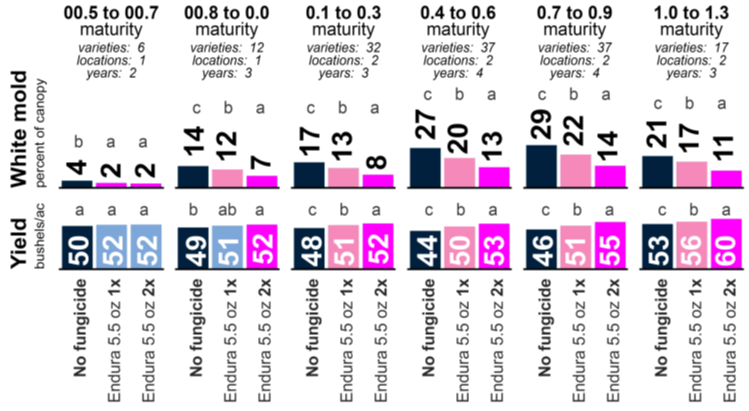
Note: Endura fungicide is Boscalid, known as Lance in Canada
Understanding R1 and R2 Growth Stages
Accurate staging is important when making fungicide timing decisions. R1 is defined as at least one open blossom on the plant. R2 is defined as at least one open blossom at one of the top two nodes.
Because white mold management depends heavily on timing, growers should monitor fields closely during early bloom and pay attention to both crop stage and canopy development.
Fungicides Must Be Applied Before Infection
Fungicide applications for white mold must be made before pathogen infection occurs. Existing disease cannot be eradicated once it is established. While some modern fungicides may provide limited curative activity, that activity is only effective within the first few hours after infection — before visible disease lesions are present and when infection can only be seen under a microscope.
This means timing is critical. Waiting until symptoms are visible is too late for effective white mold control.
New Soybean Growth Is Not Protected
One important limitation of fungicide applications is that new plant growth is not protected after application. Fungicide only protects the plant biomass that is present at the time it is applied.
This is especially important for white mold management because soybeans can put on significant new growth during early bloom. As a result, application timing must balance disease risk, canopy closure, and the amount of plant tissue present at the time of spraying.
Manitoba Disease Observations in 2025
In Manitoba soybean fields assessed at the R6–R7 stages in late August and early September 2025, white mold was recorded across multiple regions. The data showed white mold prevalence in Manitoba at 65% of fields, with 12% incidence in fields where the disease occurred.
Regional results varied. White mold prevalence was reported at 77% in Central Manitoba, 33% in Eastern Manitoba, 56% in the Interlake, 50% in the Northwest, and 80% in the Southwest.
|
Despite the presence of some white mold in 2025, Manitoba’s average soybean yield came in at 42.5 bu/acre, which was 2.5 bu/acre less than 2024.
Key Takeaways for Growers
White mold management requires a proactive approach. Growers should pay close attention to soybean maturity, bloom stage, canopy closure, and disease-favourable conditions when deciding whether and when to apply fungicide.
The most important takeaway is that fungicide applications must be made before infection occurs. Once visible symptoms appear, control options are limited. Monitoring fields closely during early bloom and aligning fungicide timing with crop stage and disease risk can help support more effective white mold management.
Credit: Michael Wunsch, North Dakota State University Research Extension Center